

50/30/20 forces structure most people never consider or put into action. For a $75K household saving 20% , ~$15K/year, the math produces a retirement supporting roughly $100K in annual spending. Clean, easy to understand, and correct. For high earners, it quietly falls short, not because 20% is wrong, but because the retirement it funds isn't the one you're building toward.
The Short Version
50/30/20 was calibrated for median incomes — the math strains at higher earning levels
Higher income raises your savings and your lifestyle target simultaneously
20% produces a bigger absolute number, but your retirement costs more too
Define your number first, then back into the rate
For most high earners, the honest answer lands at 25–30%+
What Breaks at Higher Incomes
When income rises, two things happen simultaneously:
Savings go up. A $400K household saving 20% puts away $80K/year. That feels like serious progress.
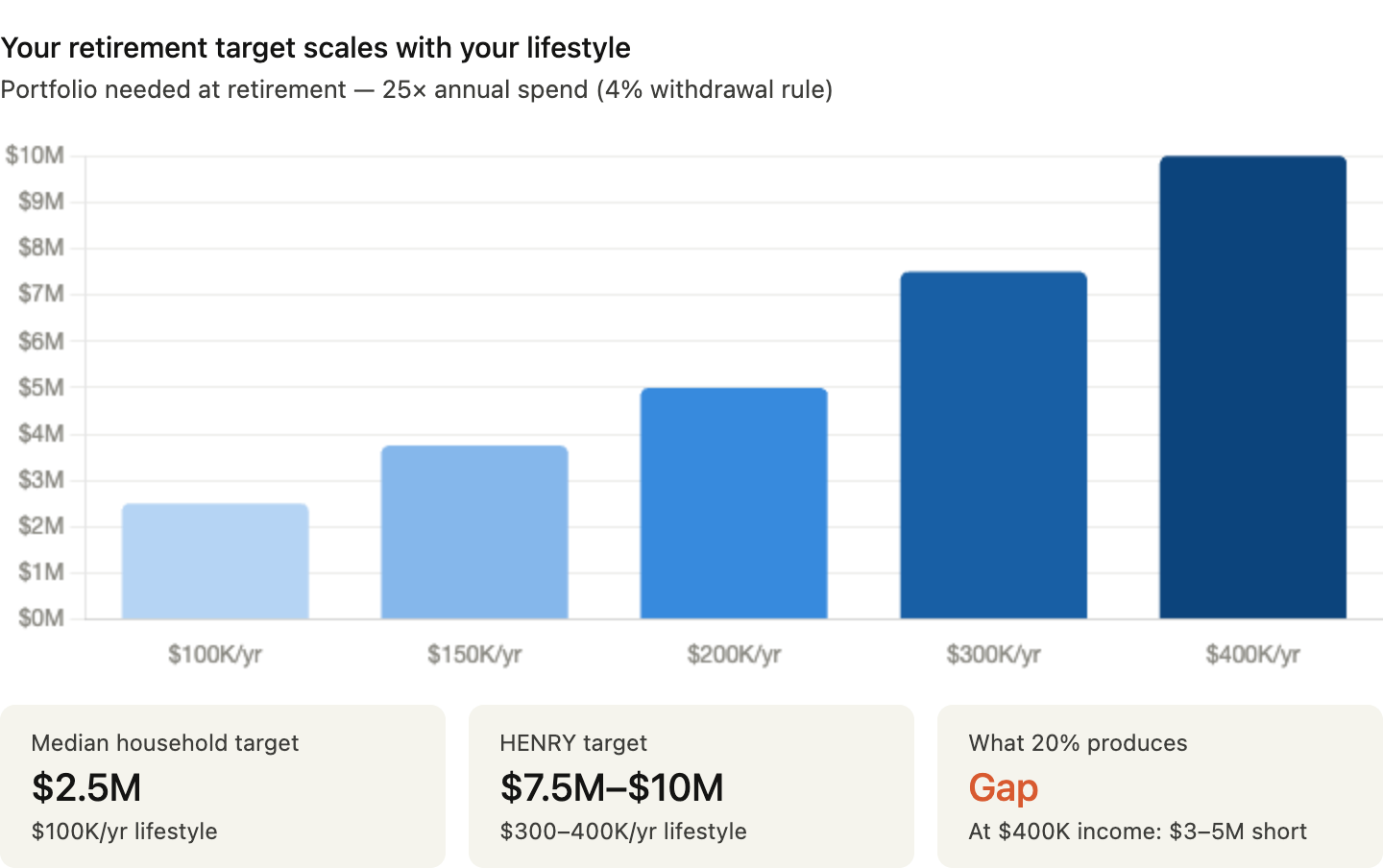
The retirement target goes up too. If your lifestyle runs $250K/year — travel, the home, the life you’ve built — you need roughly $6.25M to sustain it. That’s 25x annual spend (4% rule), the standard withdrawal math.
At $80K saved per year, even with compounding, that target takes significantly longer than most people expect. The 20% that felt disciplined at $150K income starts to look thin at $400K.
Here’s the math played out:
Household income: $400K. Saving 20% = $80K/year.Lifestyle spend in retirement: $250K/year.
Target portfolio needed: $6.25M
Years to get there from $500K starting balance at 7% return: ~28 years. Bump the savings rate to 30% ($120K/year): ~22 years.
Six years of your life, bought back by one decision.
The right sequence
Most people start with the savings rate and hope the outcome works. The better approach runs in reverse:
Define the retirement. What do you actually spend - adjusted for what goes away (mortgage, commute) and what goes up (travel, healthcare, time)?
Calculate the target. Annual spend × 25. That’s your number.
Back into the rate. What savings rate, applied to your income and current assets, gets you there in the window you want?
For most high earners running this honestly, the rate that comes back isn’t 20%. It’s 25–30%, often more… especially in your 30s and 40s when compounding has the most runway.
Playing the Long Game
20% is a starting point, not a destination. The high earners who get this right aren't the ones who saved the most — they're the ones who defined their number first and built the rate around it. The rule tells you how to save. It doesn't tell you what you're saving for.
Interested in Learning More?
Let’s start with a short, 20-minute conversation to see if there’s an opportunity to improve clarity, structure, or long-term outcomes.
Upholdings Private Wealth is a registered investment adviser in applicable jurisdictions. Registration does not imply any specific level of skill or training.
This newsletter is provided for informational and educational purposes only and does not constitute investment, tax, legal, or accounting advice. It is not an offer or solicitation to buy or sell any securities or investment strategies.
Past performance is not indicative of future results. Investing involves risk, including the potential loss of principal. There is no guarantee that any strategies discussed will achieve desired outcomes.
Information is provided “as is” without warranty as to accuracy or completeness, and opinions expressed are subject to change without notice.