

You max your 401(k) every year. Your CPA files on time. And the child tax credit still shows up as a fraction of $2,200 per kid. Sometimes it’s zero.
Credits phase out as income rises. For married couples, the child tax credit starts shrinking at $400K of MAGI, by $50 for every $1,000 over the line.
Deductions work on a different part of the return, so they feel like a separate topic. The deductions you control decide how much of the credit you keep.
Most households connect the two after the return is filed. By then, payroll deferrals, the biggest lever, are locked.
The Short Version
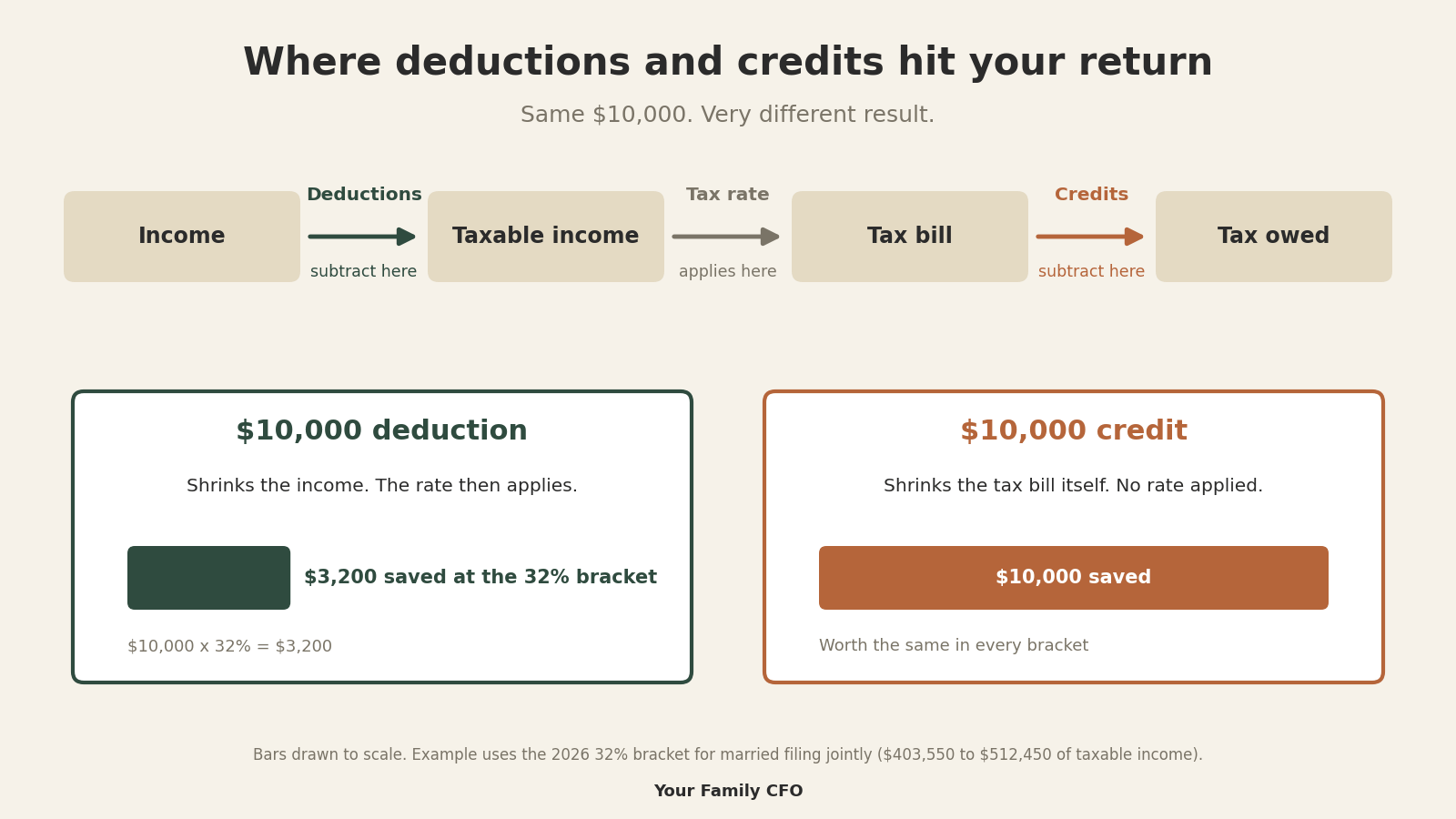
A deduction lowers the income you’re taxed on. A credit lowers the tax itself, dollar for dollar.
At the 32% bracket, you’d need about $6,900 of deductions to match one $2,200 child tax credit.
Credits phase out by income. For married couples, the child tax credit starts shrinking at $400K of MAGI.
Deductions that lower MAGI can bring a credit back. In the phase-out range, each dollar you defer saves your bracket rate plus 5 cents.
Payroll deferrals only count if they come out of a 2026 paycheck. Mid-October is when you change the election.
Deductions
A deduction reduces income before the tax rate applies. Its value is your marginal rate, so the same deduction is worth more to you than to someone in a lower bracket.
The ones you’ll actually use:
Payroll and account contributions
Pre-tax 401(k) or 403(b): $24,500
HSA: $4,400 single, $8,750 family
Health FSA: $3,400
Dependent care FSA: $7,500
These four technically come off your W-2 before it’s reported, but they lower your AGI exactly the way a deduction does.
On the return
Standard deduction: $32,200 married filing jointly
Mortgage interest
State and local taxes: capped at $40,400 for 2026, and the cap shrinks for higher earners
Charitable gifts: cash, appreciated stock, donor-advised fund contributions
Medical expenses above 7.5% of AGI
If you own a business
Qualified business income deduction
SEP-IRA or solo 401(k) contributions
Pros: Value scales with your bracket. A $10,000 deduction at 32% saves $3,200. Most of the useful ones are in your control until December 31.
Cons: Always worth less than face value. Itemized deductions do nothing until they clear $32,200.
Best for: Anyone in the 24% bracket or higher with room left in their accounts.
Credits
A credit subtracts directly from the tax you owe. A $2,200 credit saves $2,200 whether you’re in the 12% bracket or the 35% bracket.
The ones you’ll actually run into:
Child tax credit: $2,200 per child under 17, starts shrinking at $400K married filing jointly
American Opportunity credit: up to $2,500 for the first four years of college, gone by $180K
Lifetime Learning credit: up to $2,000, gone by $180K
Child and dependent care credit: up to $1,200 for two kids at your income level
Adoption credit: up to $17,670
Foreign tax credit: shows up when your taxable account holds international funds, and it doesn’t phase out with income
Pros: Dollar for dollar. Nothing beats it per dollar.
Cons: Almost all of them phase out by income. The education credits are gone by $180K for married couples. The child tax credit starts shrinking at $400K.
Best for: Households under the thresholds, or close enough to get back under.
Where they collide
Here are a few examples:
Child Tax Credit
The child tax credit drops $50 for every $1,000 of MAGI over $400K, rounded up. Two kids is $4,400 of credit. It’s fully gone at $488K.
Say your household MAGI is $440K with two kids. You’re $40K over, so you lose $2,000. Your credit is $2,400.
Now run $24,500 through one pre-tax 401(k) and $8,750 through a family HSA. MAGI drops to $406,750. You’re $6,750 over, which rounds to $7,000, so you lose $350. Your credit is $4,050.
That’s $1,650 of credit you got back. It’s on top of the regular tax savings from the $33,250 you deferred.
Here’s the part nobody mentions.
Inside the phase-out range, every dollar you deduct also restores 5 cents of credit. At the 32% bracket, you’re effectively saving 37 cents per dollar. The contribution is worth more than your bracket says.
Daycare
The child and dependent care credit gives high earners 20% of the first $6,000 of expenses for two kids. That’s $1,200 max.
A $7,500 dependent care FSA saves roughly $2,400 at 32%. And every dollar run through the FSA comes out of the expenses the credit can use. It’s one or the other for the same dollars, and the FSA wins.
Playing the Long Game
Credits get the attention because the number is printed on the form.
Deductions do the work, because they decide how much of the credit you’re allowed to keep.
Run your 2026 MAGI this week, find the gap, and close it through payroll before the last paycheck of the year.
Interested in Learning More?
Let’s start with a short, 20-minute conversation to see if there’s an opportunity to improve clarity, structure, or long-term outcomes.
Check out our website.
Upholdings Private Wealth is a registered investment adviser in applicable jurisdictions. Registration does not imply any specific level of skill or training.
This newsletter is provided for informational and educational purposes only and does not constitute investment, tax, legal, or accounting advice. It is not an offer or solicitation to buy or sell any securities or investment strategies.
Past performance is not indicative of future results. Investing involves risk, including the potential loss of principal. There is no guarantee that any strategies discussed will achieve desired outcomes.
Information is provided “as is” without warranty as to accuracy or completeness, and opinions expressed are subject to change without notice.