

Concentrated stock is a good problem to have.
The old adage of “Wealth is built through concentration and preserved through diversification” rings true, but at a certain point the same position that created your net worth turns into the biggest risk on your balance sheet. You know you should diversify but the tax cost of selling makes you question the whole decision.
At the same time, most people have a generous heart and the more accumulated, the more given. The two of these can work in tandem, creating an opportunity to diversify and donate together.
The Short Version
Liquidating concentrated stock triggers a massive tax event that permanently reduces your investable capital.
Donating appreciated stock to a Donor-Advised Fund eliminates the capital gains tax entirely and generates a charitable deduction at full market value.
The deduction reduces your ordinary income tax bill creating real savings you can reinvest into a diversified personal portfolio.
The DAF itself becomes a second portfolio where your donated stock grows independently, earmarked for giving on your timeline.
You’re not choosing between wealth and charity. You’re restructuring one position into two compounding functions building your entire family wealth.
What Liquidation Actually Costs
A real client scenario:
Annual income of ~$750k
California Resident
Tax Rates:
Federal: ~30%
State: ~13%
LTCG: 20%
NIIT: 3.8%
Concentrated Google position
Desire to trim the position by $500k at a $50k cost basis
Sell the shares at the LTCG rate - that’s $166K in taxes on the sale alone. The issue is, the sale inflates your AGI, pushing more of your ordinary income into higher brackets - that is some serious damage.
In total, the liquidation path costs north of $330K in combined federal and state taxes.
That $500K position becomes roughly $339K of investable capital. A third of your wealth evaporated before you could redeploy it.
That’s the tax leak most people accept as inevitable.
The DAF Mechanics
A Donor-Advised Fund lets you donate appreciated stock directly without making a single sale or triggering a single capital gain.
The stock transfers into the DAF at full FMV. You receive a charitable deduction for the entire amount. Then, the DAF liquidates and reinvests into a more diversified portfolio with zero tax consequence (think IRA mechanics).
The deduction might not hit all at once, though. For gifts of appreciated stock, the IRS limits your charitable deduction to 30% of AGI per year. Anything above that limit carries forward for up to five years (use it or lose within that range).
In practice, that means a $500K donation against $675K–$830K of AGI gets absorbed across two to three tax years. Each year, the deduction reduces your taxable income at your marginal rate of both federal and state, generating real, compounding tax savings that extend well beyond the avoided capital gains.
The DAF is irrevocable. The money is committed to charitable use. But you control the timing, the recipients, and the investment allocation inside the fund. There’s no rush to distribute. The portfolio grows tax-free until you’re ready to give.
The Dual-Engine Strategy
Here’s what the DAF strategy actually builds:
You take the total tax savings, the full benefit of the deduction flowing through your return across multiple years, and reinvest it into a diversified personal brokerage account.
The amount inside the DAF is diversified and compounding independently, earmarked for giving.
You now have two portfolios instead of one concentrated position.
Let’s look at the numbers from our client example:
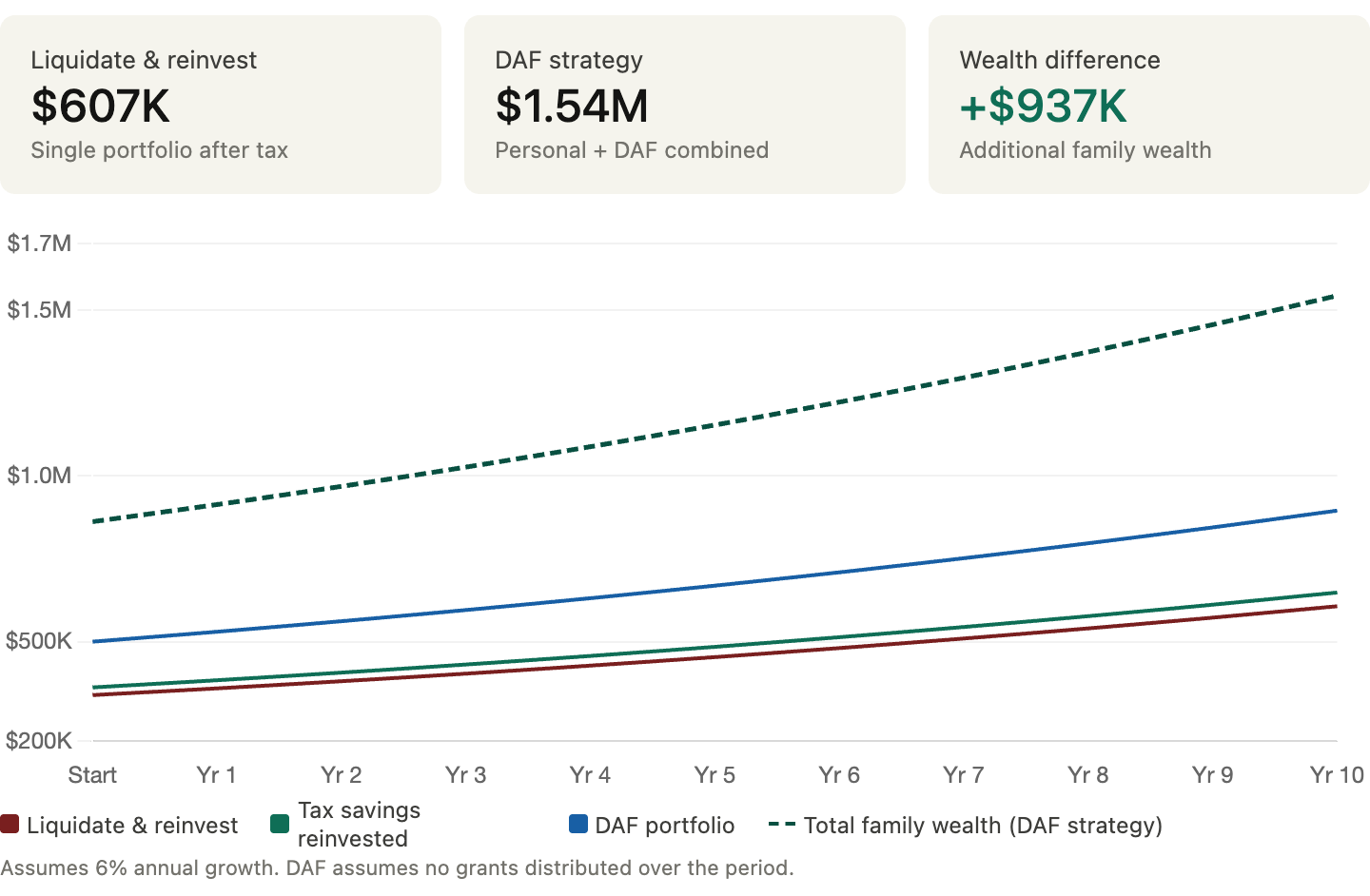
Over a decade at 6% growth, the liquidation path compounds to roughly $607K. That $500k position grows by only $107k over 10 years… through selling and diversifying.
The DAF path tells a different story. The reinvested tax savings compound to $648K in your personal brokerage. The DAF portfolio grows to $895K. Total family wealth: $1.54M.
That’s $937K more than liquidation… from exactly the same starting position.
One path paid the tax. The other restructured around it.
To Be Clear: How the Savings Get Reinvested
The tax savings don’t show up as a refund check. They show up as a lower tax bill.
Your CPA adjusts your estimated payments or W-4 withholding to reflect the reduced liability. Take-home cash goes up. You invest the difference.
If you’re sitting on additional concentrated stock, it gets better. The deduction creates tax capacity which absorbs income, meaning you can sell additional shares at a lower effective rate. The donation didn’t just eliminate tax on the gifted shares but also reduced the cost of diversifying everything else.
Either way, the savings are real and investable.
Playing the Long Game
Concentrated stock feels like a trap because most people only see two doors: hold or sell.
A DAF opens a third. You diversify the position without triggering the tax event. You capture the full deduction and reinvest the savings. And you pre-fund your giving without pulling from the portfolio you’re building for your family.
It’s not a charitable gesture dressed up as a strategy. It’s a wealth restructure that happens to fund charity… just on your terms and your timeline.
The best financial decisions aren’t the ones that feel dramatic. They’re the ones that quietly rearrange the pieces so everything compounds in the same direction.
Interested in Learning More?
Let’s start with a short, 20-minute conversation to see if there’s an opportunity to improve clarity, structure, or long-term outcomes.
Upholdings Private Wealth is a registered investment adviser in applicable jurisdictions. Registration does not imply any specific level of skill or training.
This newsletter is provided for informational and educational purposes only and does not constitute investment, tax, legal, or accounting advice. It is not an offer or solicitation to buy or sell any securities or investment strategies.
Past performance is not indicative of future results. Investing involves risk, including the potential loss of principal. There is no guarantee that any strategies discussed will achieve desired outcomes.
Information is provided “as is” without warranty as to accuracy or completeness, and opinions expressed are subject to change without notice.