

Year-end is the best time to look at how your investments get taxed, because December decisions shape your 2026 return and the years after it.
Every fund in a taxable account has a tax profile. Some funds quietly pass gains to their shareholders each December. Others don’t. Most people never see the difference until it shows up on a 1099, when it’s too late to do anything about it.
The good news is that this one is easy to learn and easy to check. Once you know how mutual funds and ETFs handle gains differently, you can decide what to hold, what to buy next, and when to make a change, with a few weeks left to act.
That’s what this issue covers. How the tax bill gets created, how ETFs avoid most of it, and a simple way to decide whether your older funds are worth keeping.
The Short Version
Mutual funds pass realized gains to everyone holding shares on the record date, and those gains are taxed to you whether or not you sell.
You can owe tax in December on gains the fund realized months before you bought.
Most broad equity ETFs rarely do this because of how their shares are redeemed.
Selling an old fund to switch can trigger the same tax, so the exit needs a plan.
You can check all of this yourself in about an hour.
Where the bill comes from
A mutual fund is a pool. Every time the manager sells a holding at a profit, that gain is realized inside the fund.
Funds also sell to meet redemptions. When other investors cash out, the manager sells holdings to raise the cash, and that can realize gains too.
By law, the fund passes those gains to shareholders each year, mostly in November and December. You receive a capital gain distribution based on the shares you hold on the record date, usually early to mid December.
Two details matter:
The gain is taxed as long-term no matter how long you’ve owned the fund. Five days or fifteen years, same treatment.
It’s taxable even if you reinvest it. Reinvesting raises your cost basis, so you don’t pay twice, but you do pay once.
Your share price drops by the payout, so you aren’t richer. You just owe tax.
Why ETFs mostly skip it
When big investors redeem ETF shares, the ETF usually hands over the underlying stocks in kind instead of selling them. The lowest-basis shares go out first.
No sale means no realized gain. That flushes the embedded gains out of the fund without a tax event for you.
This is why broad equity index ETFs have historically paid little to no capital gains.
Here’s what that looks like on $500,000 over 10 years:
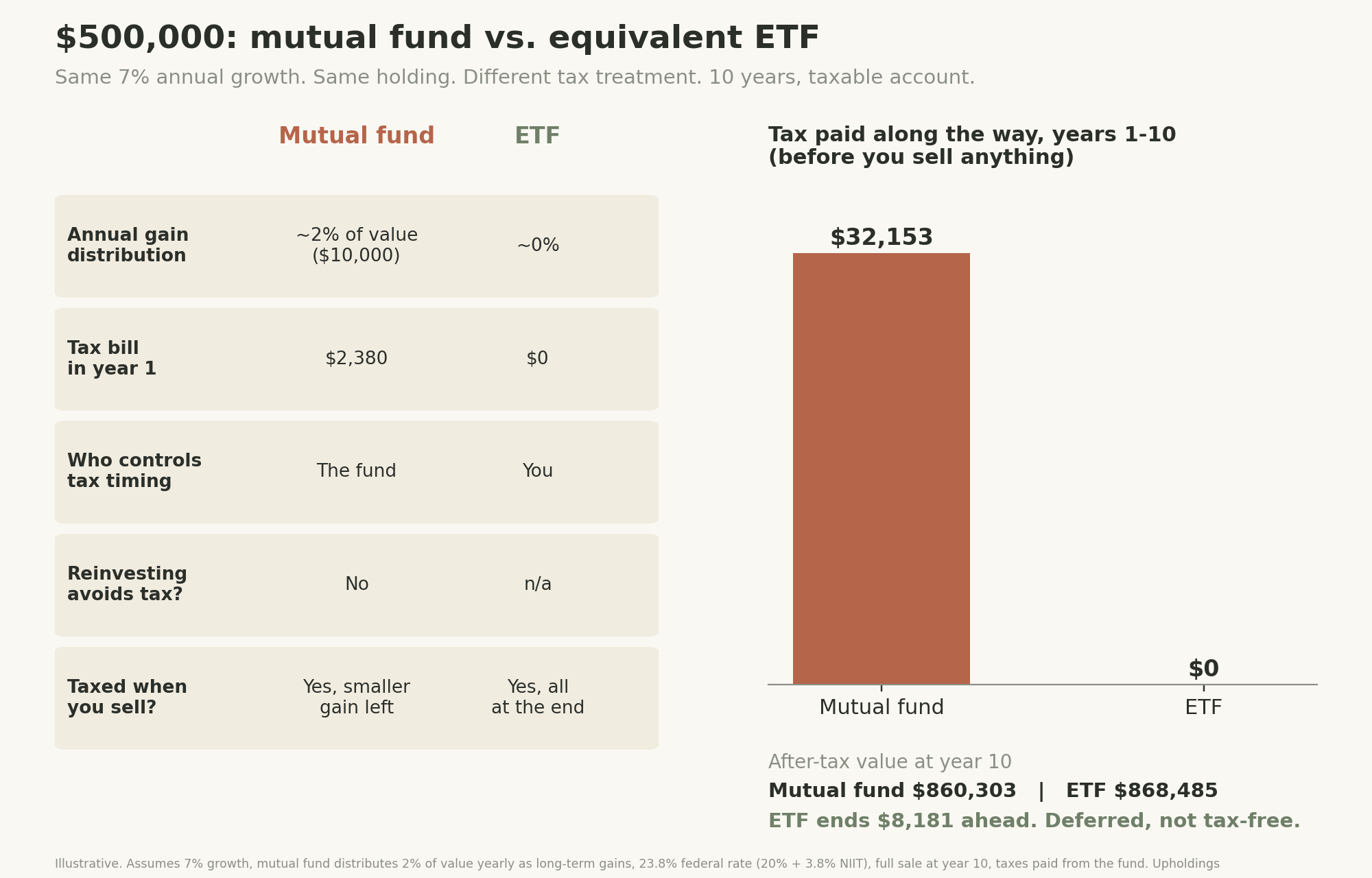
The mutual fund in this example pays about $32,000 in tax along the way. The ETF pays nothing until you sell.
Notice the ETF isn’t tax-free. It defers the bill, and a deferred bill gets to keep compounding. That’s where the roughly $8,000 gap comes from.
It also has limits. Bond ETFs pay interest taxed as ordinary income. Some active ETFs and a few commodity structures still distribute gains. Look at the fund’s history, not the label.
The CFO decision: swap or hold?
Replacing an old fund means selling it. The sale realizes whatever gain you’re sitting on, which is the bill you’re trying to avoid.
Four options, in order of how often they apply.
1. Small gain or a loss: swap now.
The cost of leaving is low. Sell, replace, done. A loss also gets harvested.
2. Large gain: pair the sale with harvested losses.
Losses realized elsewhere in the taxable account offset the gain dollar for dollar. If you sell something at a loss, don’t buy a substantially identical security within 30 days before or after, or the loss is disallowed.
3. Charitable giver: gift the shares.
Donate the most appreciated shares to a donor-advised fund. You skip the tax on the gain and, if you itemize, deduct the fair market value of shares held over a year. Fund your usual giving with cash instead.
4. Large gain, nothing to offset: stop adding.
Send new money to an ETF. The old fund shrinks as a share of the portfolio and the gain stays unrealized. If you hold it until death, your heirs get a stepped-up basis and the gain is gone.
Do this before December 31
List every mutual fund you own in a taxable account. Include your spouse’s.
Pull the unrealized gain on each.
Find each fund’s estimated distribution and record date.
Pick one of the four moves for each.
Confirm your year-to-date gains and losses with your CPA before you sell. Confirm the 2026 charitable deduction rules before any DAF gift.
Don’t buy a mutual fund in a taxable account before its record date has passed.
Playing the Long Game
A legacy fund isn’t a reason to overpay the IRS, and it isn’t a reason to hold forever. Close the books on it this month, and choose the exit on purpose.
Interested in Learning More?
Let’s start with a short, 20-minute conversation to see if there’s an opportunity to improve clarity, structure, or long-term outcomes.
Check out our website.
Upholdings Private Wealth is a registered investment adviser in applicable jurisdictions. Registration does not imply any specific level of skill or training.
This newsletter is provided for informational and educational purposes only and does not constitute investment, tax, legal, or accounting advice. It is not an offer or solicitation to buy or sell any securities or investment strategies.
Past performance is not indicative of future results. Investing involves risk, including the potential loss of principal. There is no guarantee that any strategies discussed will achieve desired outcomes.
Information is provided “as is” without warranty as to accuracy or completeness, and opinions expressed are subject to change without notice.
The part that really stings is the record-date trap. You buy a fund in late November and suddenly owe taxes in December on gains it realized months before you even owned it. You're paying someone else's tax bill. An ETF can often avoid that by handing over shares instead of selling them and triggering gains. Same market, different wrapper, very different tax outcome.