

I’ve got clients here in Charleston who’ve been doing this for years without calling it a strategy. Kids in private elementary school, tuition due twice a semester. Instead of writing the check straight to the school, they run it through a 529 first - contribute it, deduct it on the South Carolina return, pull it back out a few weeks later, pay the tuition. Same money, same school, same year. They just keep some of it that they wouldn’t have otherwise.
The Short Version
OBBBA doubled the federal cap on tax-free 529 withdrawals for K-12 tuition - $10,000 to $20,000 per beneficiary, effective this year.
OBBBA also added new qualifying K-12 expenses: curriculum, tutoring, test fees, dual enrollment.
Whether your state’s deduction follows that federal change is a separate call each state makes on its own.
A South Carolina family with three kids at $10,000/year tuition each nets $1,563 back doing this.
Federal vs. State
There are two different systems stacked on top of each other here, and they don’t have to agree.
Federal law decides whether a 529 withdrawal is tax-free at all, and what counts as a qualifying expense - that’s the layer OBBBA just changed.
State law decides something separate: whether you get a deduction for contributing in the first place, and whether that deduction survives if you use the money for something like K-12 tuition.
States aren’t required to follow federal law on this, and plenty don’t. So the same federal rule, applied to the same withdrawal, can land you in completely different places depending on where you live.
What OBBBA Actually Changed
The One Big Beautiful Bill Act, effective for 529s starting this year, did two things federally.
It doubled the annual cap on tax-free withdrawals for K-12 tuition, from $10,000 to $20,000 per beneficiary.
It expanded which K-12 expenses qualify well past tuition: curriculum and textbooks, tutoring, educational therapy, standardized test fees, dual enrollment costs for kids taking college classes early.
It also opened 529s to postsecondary credentialing programs for the first time: nursing assistant certifications, cosmetology licenses, trade apprenticeships.
None of that touches your state return. That’s a separate decision, and it’s where things get uneven.
How States Differ
More than 30 states plus DC offer some kind of 529 deduction or credit.
Nine have no income tax, so a deduction is moot: Alaska, Florida, Nevada, South Dakota, Tennessee, Texas, Washington, Wyoming, New Hampshire.
Four income-tax states give no 529 benefit at all: California, Hawaii, Kentucky, North Carolina.
Most states only deduct contributions to their own in-state plan.
Nine states deduct contributions to any state’s plan: Arizona, Arkansas, Kansas, Maine, Minnesota, Missouri, Montana, Ohio, Pennsylvania.
But a handful of states either block the deduction outright when the money is used for K-12, or quietly net your deduction against same-year withdrawals so the two cancel each other out and you're left with no real benefit. Neither shows up as a headline anywhere - it's a line item in the state's own tax code or plan documentation, easy to miss until you've already filed.
Check your specific state's plan administrator or department of revenue before you assume this works. It's usually stated plainly, it's just easy to never go look.
South Carolina Says Yes
South Carolina is one of the more generous states on this. Future Scholar, the state’s 529, lets you deduct 100% of contributions from South Carolina taxable income - no annual cap the way some states impose one, only the plan’s lifetime account maximum, which sits well north of $500,000 per beneficiary.
There’s no minimum holding period tied to the deduction either: contribute this month, withdraw next month, same tax year, deduction stands. South Carolina’s 2026 tax reform also collapsed the old bracket structure into two rates - 1.99% on the first $30,000 of taxable income, 5.21% above it - so almost everyone sending their kids to private school hits this limit.
The Math: Three Kids, $15,000 Each
Three kids in private school, $15,000 a year apiece, $45,000 total, paid two ways.
Direct, no 529: write $45,000 in checks to the schools. Nothing comes back.
Routed through Future Scholar first, each kid on their own account since the deduction and the withdrawal cap both apply per beneficiary, not per family:
Contribute $15,000 per kid
Deduct $15,000 per kid on the South Carolina return
Withdraw $15,000 per kid as a qualified K-12 distribution
Pay each school directly, same tax year
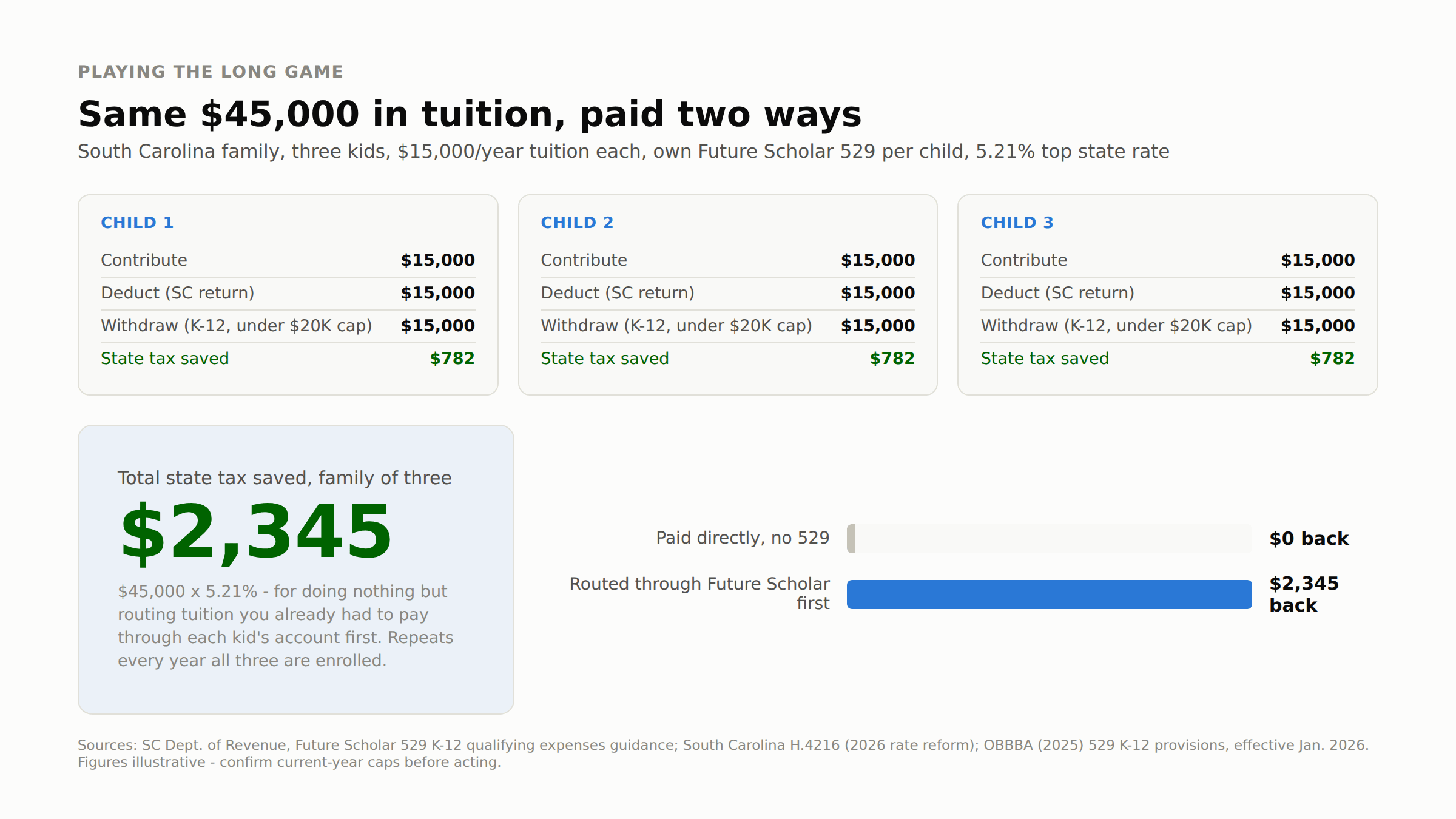
Same three schools, same tuition, same year - $1,563 you didn’t have before, for three contribution forms and three withdrawal requests. Do it every year all three are enrolled and it compounds the way anything recurring does.
Playing the Long Game
Nobody builds wealth by finding one loophole. They build it by not leaving the ordinary ones on the table, year after year, on money they were spending regardless. You’re paying this tuition bill either way. The only question is whether you’re paying it the way that gets nothing back, or the way that does.
Interested in Learning More?
Let’s start with a short, 20-minute conversation to see if there’s an opportunity to improve clarity, structure, or long-term outcomes.
Check out our website.
Upholdings Private Wealth is a registered investment adviser in applicable jurisdictions. Registration does not imply any specific level of skill or training.
This newsletter is provided for informational and educational purposes only and does not constitute investment, tax, legal, or accounting advice. It is not an offer or solicitation to buy or sell any securities or investment strategies.
Past performance is not indicative of future results. Investing involves risk, including the potential loss of principal. There is no guarantee that any strategies discussed will achieve desired outcomes.
Information is provided “as is” without warranty as to accuracy or completeness, and opinions expressed are subject to change without notice.
Every parent who sends their kids to private school should be checking out their state’s ability to sue the 529.