

A client came to us last year. $300K base, $1.2M in RSUs vesting annually. He was taking the company match in his 401(k) and nothing else. No vesting plan, no asset allocation or location plan, no after-tax contributions, no mega backdoor, tax surprises… you name the strategy and he was not utilizing it.
For most high earners, he’s not unusual. He’s the default.
While he was making a ton of money, he was not optimizing the biggest levers that the high income offered him. Starting with one vehicle, we were able to clean up the pieces step by step and develop a long-term plan moving forward.
The Short Version
The mega backdoor lets high earners move up $30-40K+/year of additional dollars into Roth, on top of the standard 401(k) limit.
Most eligible employees never use it. Not because they can’t, but because nobody’s watching the moving pieces.
The hidden upside: turning it on forces a cascade of healthier decisions…diversification, withholding, cash flow. Most people never get around to this on their own.
What It Actually Is
The mega backdoor uses a feature buried in many corporate 401(k) plans: after-tax contributions, separate from your pre-tax or Roth contributions. You max the standard $24,500 employee limit. Your employer match goes in. Then you fill the remaining space up to the $72,000 annual limit with after-tax dollars and immediately convert those to Roth.
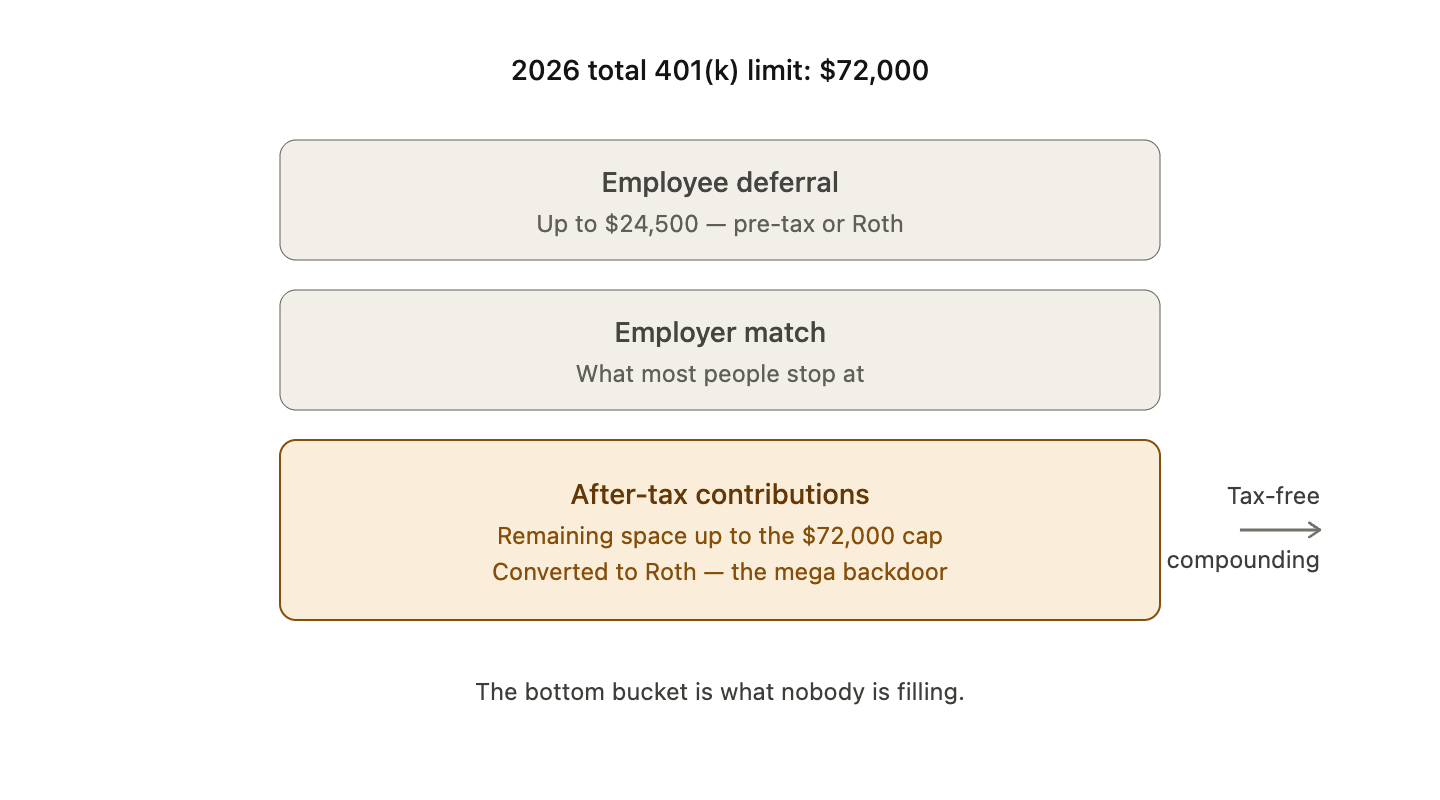
Done correctly, that's an extra $30K–$40K+ per year flowing into tax-free compounding. For our California-based client facing combined federal, state, and investment-income tax rates north of 50%, that distinction matters more than almost anywhere else in the country.
Consider a $35k per year mega backdoor contribution in your 10 highest earning years. At a 7% annual rate of return, with an additional 15 years of compounding, those proceeds grow to $1.43M… TAX-FREE… at withdrawal. Compare that to the same brokerage investment and the numbers are pretty astounding.
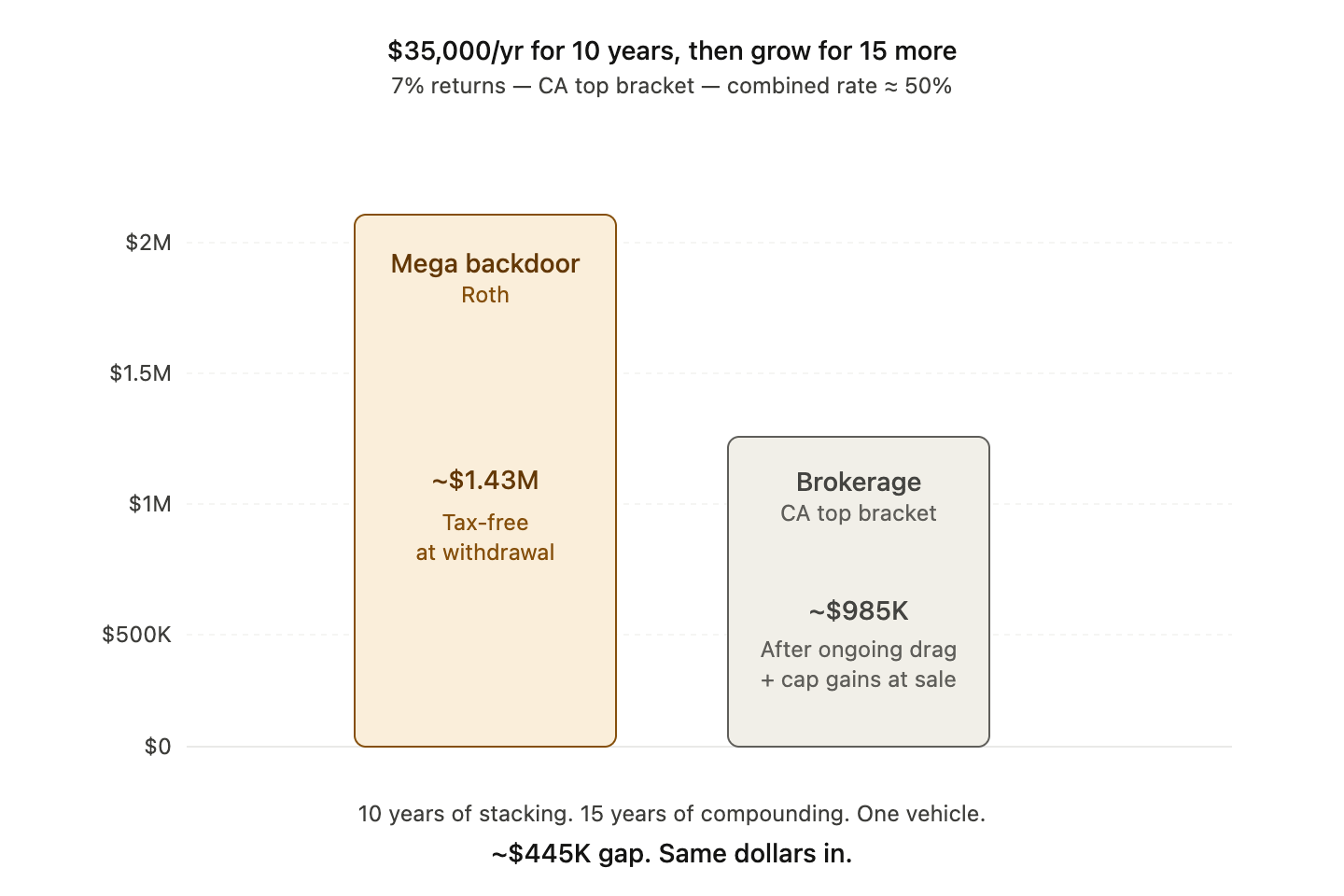
That gap isn't the result of better investments. Same dollars, same returns. The only variable is the vehicle.
Why It’s All About Coordination
Here’s why the mega backdoor reveals more than it solves.
To execute it, four things have to happen in sync:
Your plan has to allow after-tax contributions and in-plan conversions… somebody has to read the plan document.
Your payroll has to be set correctly to max the after-tax bucket without overshooting.
The conversions have to happen quickly enough that the after-tax dollars don’t generate taxable growth.
The whole thing has to coordinate with your equity comp, bonus timing, and quarterly tax planning so you’re not creating a cash flow problem elsewhere.
While it is certainly a tax strategy, it can be a logistical nightmare for any individual on their own.
If nobody is sitting between your CPA, your payroll, your equity comp, and your investment accounts, the mega backdoor doesn't get done. Not because it's complicated but because it requires someone whose job is to make sure all the pieces talk to each other.
The Forcing Function
Turning the mega backdoor on for our client unlocked the core benefit - a total systematic reboot.
Maxing the after-tax bucket meant another ~$3,000/month leaving his paycheck. That cash had to come from somewhere and the answer wasn't to just spend less… his lifestyle was already locked in.
The answer was to start systematically selling RSU vests to fund monthly cash flow. Suddenly the concentrated position he'd been sitting on for years was getting trimmed with every new vest. The mega backdoor created a non-negotiable cash need that the RSUs were the natural place to fill creating a diversification mechanism away from an already concentrated position.
The mega backdoor didn’t just turn into tax-free compounding but with proper structure it forced:
Diversification - RSUs get sold systematically to fund cash flow, not held by default
Withholding discipline - under-withholding gets fixed because the cash pressure is now monthly, not annual
Lifestyle clarity - you find out fast whether your real spending fits inside your real income, with the equity comp treated as bonus rather than baseline
Three behaviors that high earners almost never adopt voluntarily. One vehicle that forces all three.
Playing the Long Game
Tactics in isolation are interesting. Coordinated tactics compound. The best moves do double duty. If you’re not sure whether your pieces are actually working together, that’s the conversation worth having.
Interested in Learning More?
Let’s start with a short, 20-minute conversation to see if there’s an opportunity to improve clarity, structure, or long-term outcomes.
Upholdings Private Wealth is a registered investment adviser in applicable jurisdictions. Registration does not imply any specific level of skill or training.
This newsletter is provided for informational and educational purposes only and does not constitute investment, tax, legal, or accounting advice. It is not an offer or solicitation to buy or sell any securities or investment strategies.
Past performance is not indicative of future results. Investing involves risk, including the potential loss of principal. There is no guarantee that any strategies discussed will achieve desired outcomes.
Information is provided “as is” without warranty as to accuracy or completeness, and opinions expressed are subject to change without notice.