

We signed a new client a few months back who had a great situation… strong salary, decent RSU package, great benefits, etc. When we started discussing the ESPP option he was pretty direct about it: he wasn’t sold on his company’s stock. Didn’t want more concentration. Didn’t see the point of adding another position tied to the same employer already paying his salary and vesting his RSUs.
It was a reasonable instinct. It was also the wrong conclusion.
The mistake he was making, and it’s one I see constantly, is thinking of ESPP as a stock pick. It isn’t. It’s a mechanism. And once you separate those two things, the math makes the decision for you.
The Short Version
ESPP lets you buy company stock at a discount, typically 15%, and often with a look back provision that makes the real return 20–30%+ annualized
Most employees either skip it, under-contribute, or hold too long after purchase
The right move for most people: max enrollment, sell immediately, repeat every cycle
Selling immediately isn’t pessimism about your company… it’s how you capture the return the mechanism was designed to give you
This isn’t a stock decision… it’s a cash flow decision
What You’re Actually Being Offered
An Employee Stock Purchase Plan (ESPP) lets you buy company stock at a discount through payroll deductions over a 6-month offering period.
Most plans include a look back provision: at the end of the period, you buy at 15% off whichever price is lower: the opening price or the closing price. That’s the detail most people miss. It means the market working against you still doesn’t eliminate the return.
The discount is the return. The stock is just the delivery mechanism.
The Math, Run Cleanly
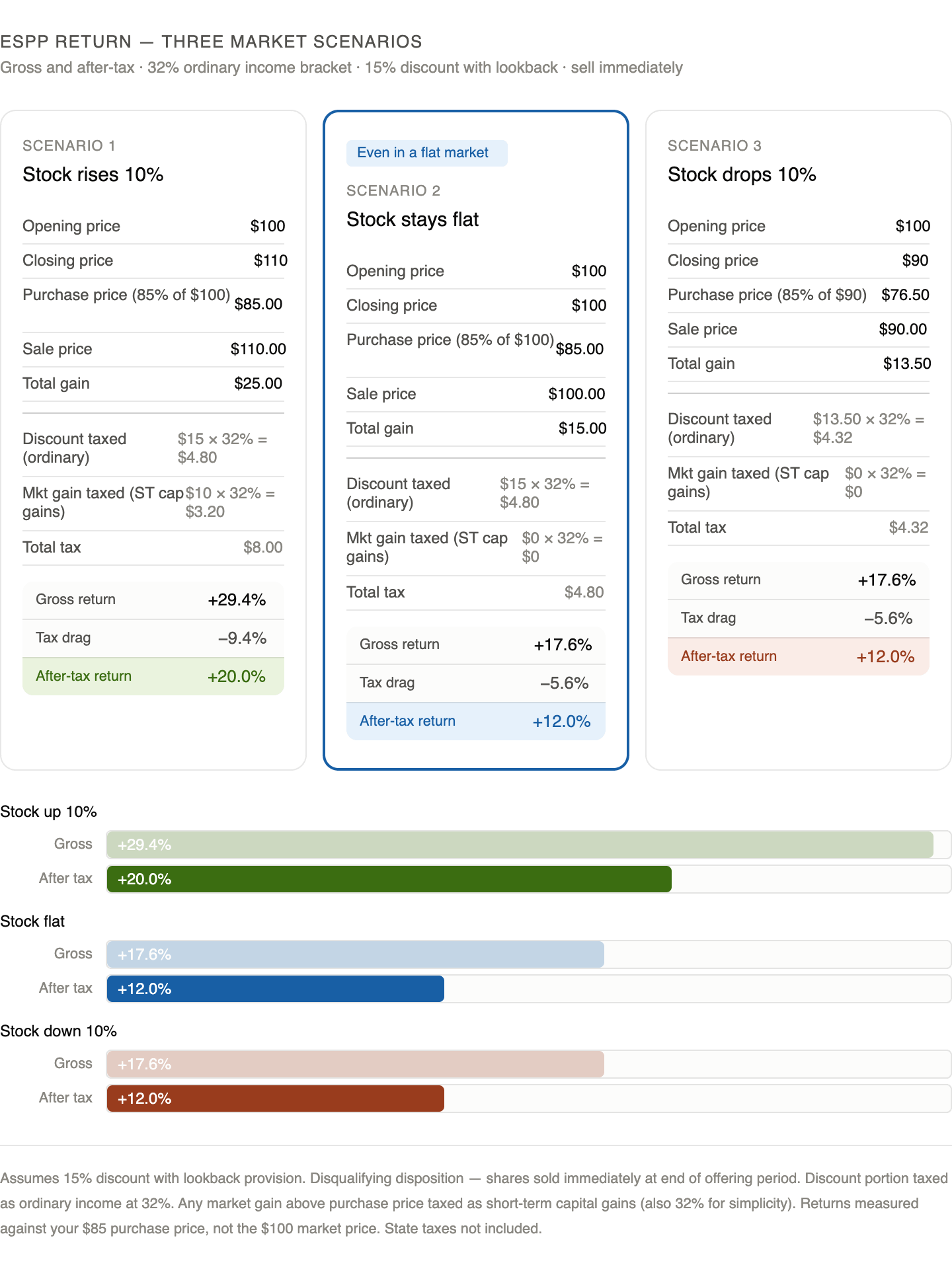
Say your stock opens the period at $100 and closes at $110. With a look back, you buy at $85, 15% off the lower starting price. Let’s remember, the actual market value is $110… that’s an immediate 29% return before your company does anything exceptional.
Now run the flat scenario. Stock stays at $100. You buy at $85, sell at $100. That’s still an 18% gain… on a 6-month cycle. Annualized, you’re looking at roughly 32%.
That is not a rounding error. That is a structured return sitting in your benefits portal waiting to be collected.
How the IRS Sees It
When you sell ESPP shares, the tax treatment depends on one thing: how long you held them after purchase.
Hold for less than two years from the offering date and one year from the purchase date and you trigger a disqualifying disposition. The discount you received is taxed as ordinary income. Any additional gain above that is taxed as a short-term capital gain.
Hold longer and you get a qualifying disposition. The tax treatment is more favorable on paper because part of the gain shifts to long-term capital gains rates.
Why the “Better” Tax Treatment Isn’t Actually Better
The qualifying disposition sounds like the obvious move. Lower tax rate. More favorable treatment. Done.
Except the math doesn’t work out that way for most high earners.
To hit qualifying disposition status you have to hold the shares for at least two years from the offering date. That means you’re sitting in a potentially concentrated single-stock position for up to 18 months after purchase. You’re taking on real equity risk to save a few percentage points on taxes.
Here’s what that actually looks like. Say you’re in the 32% bracket. Your ESPP discount on $25,000 worth of stock is roughly $3,750. The tax difference between ordinary income and long-term capital gains on that amount is around $660.
You’re holding concentrated employer stock for 18 months to save $660.
That’s not a tax strategy.
The Three Ways People Get This Wrong
Non-enrollment. Some employees skip it entirely… too complicated, never got around to it. This is the most expensive version of financial inertia I see in high-earning households.
Under-contribution. The IRS caps ESPP purchases at $25,000 in stock value per year. Most plans allow 10–15% of salary in payroll deductions. Most employees contribute 2–3% and consider themselves participants.
Holding too long. You buy at a discount, the shares hit your account, and because you feel good about the company you hold. Now you’ve converted a near-certain gain into a concentrated stock position layered on top of your salary, bonus, and RSUs. All tied to the same employer.
The Play: Max and Sell
For most people in most situations the framework is simple. Contribute the maximum your plan allows. At the end of each offering period, sell the shares immediately. Deposit the proceeds. Repeat.
You’re not making a statement about your company. You’re collecting the return the plan was structured to deliver and then removing the single-stock risk before it compounds into a problem.
The sale triggers a disqualifying disposition, meaning the gain on the discount is taxed as ordinary income. That’s fine. You still came out well ahead, and you no longer own the downside.
Back to our client. He enrolled at the maximum, committed to selling at each period end, and stopped thinking of it as an investment decision. It became a payroll optimization.
Playing the Long Game
The best financial advantages aren’t usually complicated. They’re structural. They reward the people willing to run the math once, make a decision, and execute it without sentiment. ESPP is one of the cleaner examples… a designed return, available every six months, that most high earners are either ignoring or leaving half-collected. The mechanism does the work. You just have to use it.
Interested in Learning More?
Let’s start with a short, 20-minute conversation to see if there’s an opportunity to improve clarity, structure, or long-term outcomes.
Check out our website.
Upholdings Private Wealth is a registered investment adviser in applicable jurisdictions. Registration does not imply any specific level of skill or training.
This newsletter is provided for informational and educational purposes only and does not constitute investment, tax, legal, or accounting advice. It is not an offer or solicitation to buy or sell any securities or investment strategies.
Past performance is not indicative of future results. Investing involves risk, including the potential loss of principal. There is no guarantee that any strategies discussed will achieve desired outcomes.
Information is provided “as is” without warranty as to accuracy or completeness, and opinions expressed are subject to change without notice.