

I met with a prospect last week who had everything you’d want to see in a young business… revenue growing, costs low, margins healthy. On the flip, he had a tax bill that didn’t match any of it.
Almost all of it tied back to self-employment tax. We spent time on when, why, and how an S Corp election actually made sense for him plus the implications.
The Short Version
S Corp elections save on self-employment tax by splitting income into salary and distributions
The savings don’t kick in until net income clears the cost of running the structure… usually somewhere around $80K
That split is a decision you make once and then live with for years - make sure you revisit it
The election has a real deadline and real mechanics, not just a form you check once
On $450K of net income, the difference between structures is real money but only if the salary number is set right
The Math That Sells It
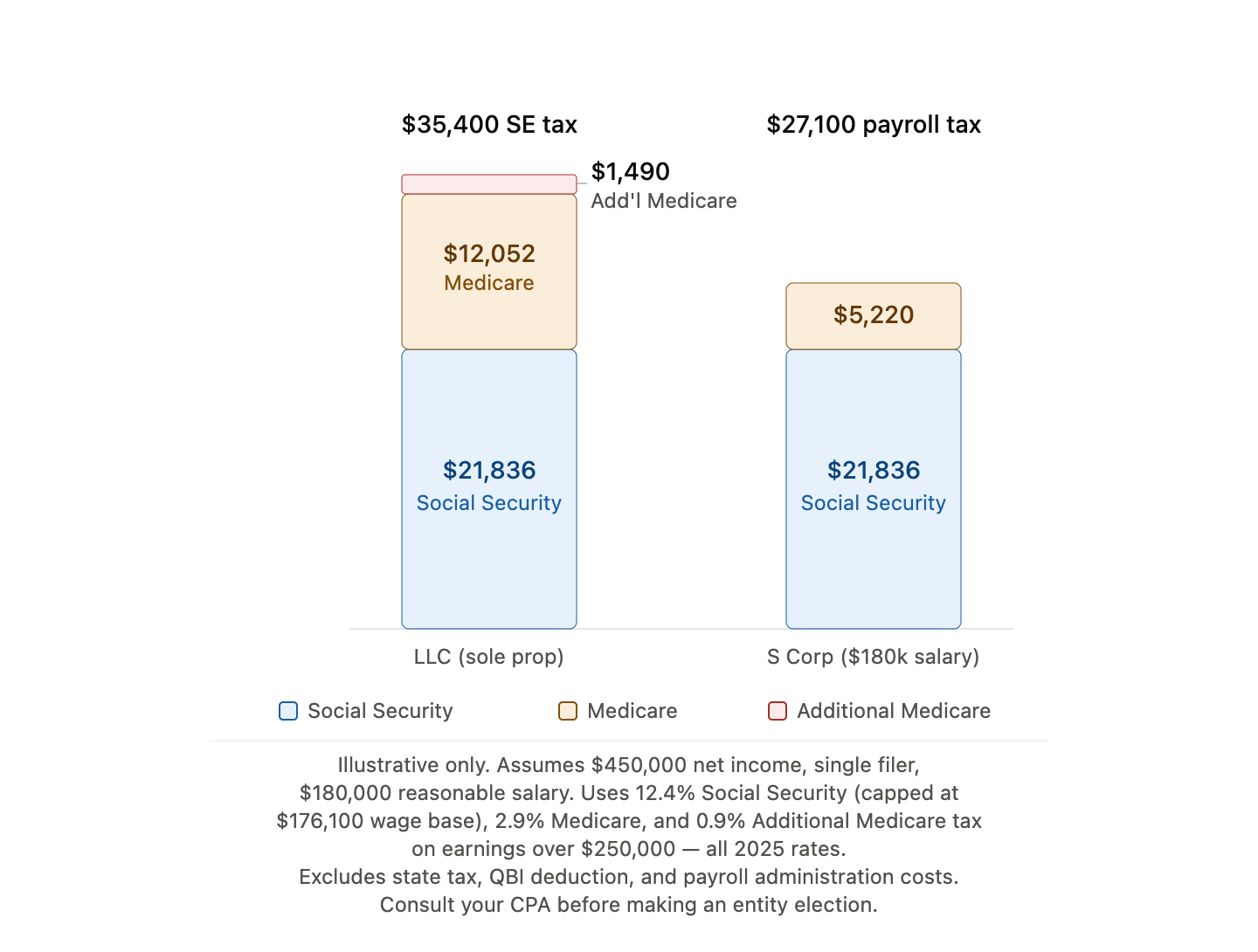
An LLC taxed as a sole proprietorship pays self-employment tax at 15.3% on all net income, with no ceiling on the Medicare piece. An S Corp lets you split income into a reasonable salary, subject to payroll tax, and distributions, which aren’t.
On $450K of net business income, a straight LLC pays roughly $35,400 in self-employment tax. Elect S Corp status, pay yourself a reasonable salary of $180K, take the rest as distributions, and the combined payroll tax comes to roughly $27,100…about $8,300 back in your pocket before the added costs of running payroll.
That's a real number but it’s also where most people stop thinking about it.
The savings aren't automatic and they show up once net income clears the cost of the structure itself. Running payroll and filing a separate return typically runs $2,000–$4,000 a year. Below roughly $80K in net income, that overhead eats most of the tax savings and you're doing extra work for very little. Above it, the math starts working clearly in your favor and keeps improving as income grows.
What the Pitch Leaves Out
The S Corp isn’t free savings, it’s a trade.
You pick up payroll administration, a separate business return, and a “reasonable salary” that has to hold up.
"Reasonable salary" is what you'd have to pay a stranger to do exactly what you. The IRS has no formula for it, just a facts-and-circumstances test based on comparable market pay for your role, industry, and hours; get caught understating it and you owe back payroll tax plus penalties, not just an amended return. And it's not a one-time number… the salary that was defensible at $150K in revenue can look understated at $600K, because the role and the market rate for it have both changed.
The salary number does more than avoid an audit flag, too. Your retirement contribution room, solo 401(k), a defined benefit plan further along, even your QBI deduction, runs off that same figure. Set it low to maximize today’s tax savings, and you may be quietly capping how much you can put away every year. Set it too high, and you’ve given back the savings you elected S Corp status to capture in the first place.
The Paperwork Nobody Mentions
The election isn’t optional paperwork you file once and forget… it’s a real deadline. You file Form 2553 within two months and fifteen days of the start of the tax year you want it to apply to. Miss that window and you’re waiting until next year.
Once elected, you’re required to run actual payroll, a W-2, withholding, quarterly filings, not just cutting yourself a check when it’s convenient. You also pick up a separate business return on top of your personal one. The election changes how you operate day-to-day, not just how you’re taxed.
So When Does It Make Sense
Boil it down and there are really three questions worth asking, in order.
Is net income clearing $80K after the S Corp costs? If not, you’re doing extra paperwork to save less than you’re spending on the paperwork.
Can you defend the salary number with real market comp for your role, not just a number that felt safe? If you can’t point to what a stranger doing your job would actually earn, you’re not ready to set one.
And has anyone actually looked at that number since you set it? Income changes, roles change, comps change… most owners never revisit the split, which means the number quietly stops fitting the business it was built for.
If you can answer all three cleanly, the election is doing its job. If you’re guessing on any of them, that’s the conversation to have before the next tax season, not after.
Playing the Long Game
The S Corp election was never a one-time form to check off, it’s a structure that has to be set up right, timed right, and revisited as the business changes. Most owners get the “why” and skip the “when” and the “how,” and that’s exactly where the savings quietly disappear.
Interested in Learning More?
Let’s start with a short, 20-minute conversation to see if there’s an opportunity to improve clarity, structure, or long-term outcomes.
Check out our website.
Upholdings Private Wealth is a registered investment adviser in applicable jurisdictions. Registration does not imply any specific level of skill or training.
This newsletter is provided for informational and educational purposes only and does not constitute investment, tax, legal, or accounting advice. It is not an offer or solicitation to buy or sell any securities or investment strategies.
Past performance is not indicative of future results. Investing involves risk, including the potential loss of principal. There is no guarantee that any strategies discussed will achieve desired outcomes.
Information is provided “as is” without warranty as to accuracy or completeness, and opinions expressed are subject to change without notice.