

My wife went back to work last week - sixteen weeks of maternity leave gone faster than either of us could have imagined. Leaving our newborn at home… the question kept coming up, is this actually worth it?
We had talked about this long before the day of reckoning. It was a discussion we had when we were engaged, again when we decided we were ready for kids, again during her pregnancy, and again after Gianni was born.
The final answer always being: The ultimate goal is to stay-at-home but we will evaluate our financial situation at that time.
And here we are, still without a permanent decision but rather a one-month trial, understanding that if tomorrow she came home and said she was done, we would be okay because we did the math… both sides of it..
The Short Version
The second income is your household’s most expensive dollar, taxed at your highest marginal rate before a single bill is paid.
A working parent gets roughly 2–3 hours of real presence with their kids on a weekday, that’s the actual time cost.
Both sides have genuine costs and genuine value: going back preserves identity and income, staying home preserves presence and keeps more of what you earn. Most couples only ever look at one side.
The Tax Picture
Most couples look at the gross salary and stop there. That’s the wrong number.
In a high-earning household, the second income isn’t taxed at an average rate but rather the top bracket the household already sits in (marginal rate). Every dollar of that second income is the most expensive dollar you earn. At the 32–35% federal bracket, plus state taxes, plus payroll, you’re losing 38–45 cents of every dollar before childcare, commuting, or any other friction cost is factored in.
This bracket effect cuts both ways.
Dropping one income doesn’t just reduce your tax bill on that income but could potentially drop your entire household’s marginal rate on the remaining income. That could amount to a meaningful shift in how much of every dollar you actually keep.
Over a decade of peak earning years, the compounding effect of keeping more of what you earn is significant. Most couples never model it because they’re focused on the gross number going away, not the net number staying.

The Cost of Time
This was the biggest decision driving our conversations. For a profession like my wife’s (nurse), where she works 12 hour shifts + charting + commuting, her total time away from the home could be 14-15 hours.
For her that means, leave when Gianni is sleeping and come back when Gianni is sleeping… virtually a full day of no real hours with him.
The average working parent, on a typical weekday, gets roughly 2–3 hours of real presence with their kids.
There is only one first year. First steps, first words, first everything - you get one shot at being present for it. That’s not sentiment. That’s the actual math of time.
And the mental load piece runs deeper than most couples admit. Two parents operating at full capacity doesn’t just strain the schedule. It runs in the background constantly — the sick day coverage, the appointment scheduling, the invisible coordination work that has no off switch and no overtime pay. That cost is real. It just doesn’t appear on a pay stub.
The Real Tradeoff
Here’s what I want to be clear about: there is no universally right answer.
There are way more factors to be considered than just what I write about, here.
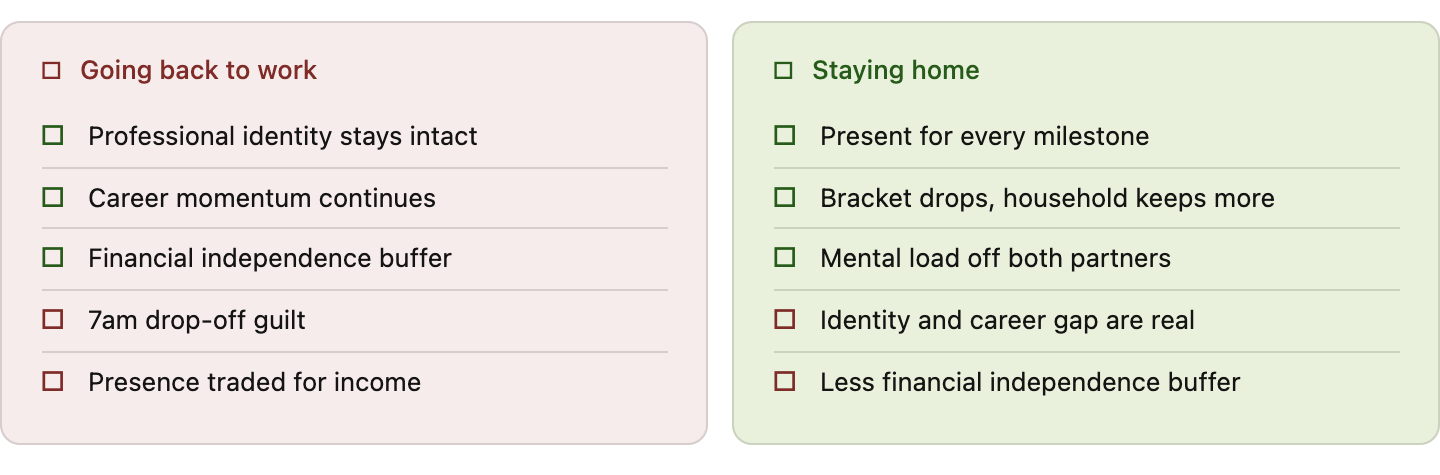
Going back to work keeps professional identity intact, maintains career momentum, and preserves the financial independence buffer that matters, especially if your plan is built around two incomes. For some families, the income isn’t optional but for others they are able to support the lifestyle they have built or are willing to make real changes for their new reality.
Staying home means being present for a season that only comes once. It could mean your tax bracket drops, the household keeps more of what it earns, and the mental load on both partners comes down.
Both sides have genuine costs. Both sides have genuine value.
The mistake most couples make isn’t choosing wrong. It is only focussing on the gross salary number without ever examining the tax picture, the cost of time, and what the actual tradeoffs are.
Our One-Month Trial
With all the above in mind, we settled on a one-month trial. This allowed us time to process the following:
Is the household actually functioning?
Is the childcare sustainable?
Is she fulfilled, or grinding through it?
Does the income, honestly accounted for, actually move the needle on anything that matters?
A month gives us data points to eventually make a decision. It may come after a month, it may come after three, or it may never come. The important part is we did our homework, we ran the math on both sides of the equation, and we are ultimately prepared if/when the day comes that she wants to be home permanently.
Playing the Long Game
Money compounds. So does the time you're present or aren't. Most couples spend 30 seconds on this decision and 30 years living with it. Run the real tax math. Sit with the real time cost. Then decide. You can always earn more later but you can’t necessarily buy back that first year. That is the ultimate tradeoff you have to measure.
Interested in Learning More?
Let’s start with a short, 20-minute conversation to see if there’s an opportunity to improve clarity, structure, or long-term outcomes.
Upholdings Private Wealth is a registered investment adviser in applicable jurisdictions. Registration does not imply any specific level of skill or training.
This newsletter is provided for informational and educational purposes only and does not constitute investment, tax, legal, or accounting advice. It is not an offer or solicitation to buy or sell any securities or investment strategies.
Past performance is not indicative of future results. Investing involves risk, including the potential loss of principal. There is no guarantee that any strategies discussed will achieve desired outcomes.
Information is provided “as is” without warranty as to accuracy or completeness, and opinions expressed are subject to change without notice.