

Over the course of the past year, we have worked with a handful of clients on estate plan implementation and upgrades. Different ages, different asset levels, different family situations. Each time the question comes up: Will vs. Trust?
It's the right question and the honest answer is that most people already have one of the two; they just don't know whether it's the right one for where they actually are now.
A will is where almost everyone starts. The problem isn’t the will. It’s that life keeps moving… income grows, assets accumulate, families get more complicated. By the time most people sit down with us, they’ve outgrown their estate plan without realizing it.
That’s the gap we’re talking about.
The Short Version
A will and a revocable living trust do different jobs.
Wills go through probate: public, slow, and court-supervised; trusts don’t.
TOD and POD designations help but they don’t cover everything, and most people don’t realize what falls through.
At a certain net worth and family complexity, the trust isn’t optional, it’s the upgrade.
The right trigger isn’t age; it’s life events (see below)
What a will vs. trust do?
A will tells the court what you want to happen after you die. That’s it.
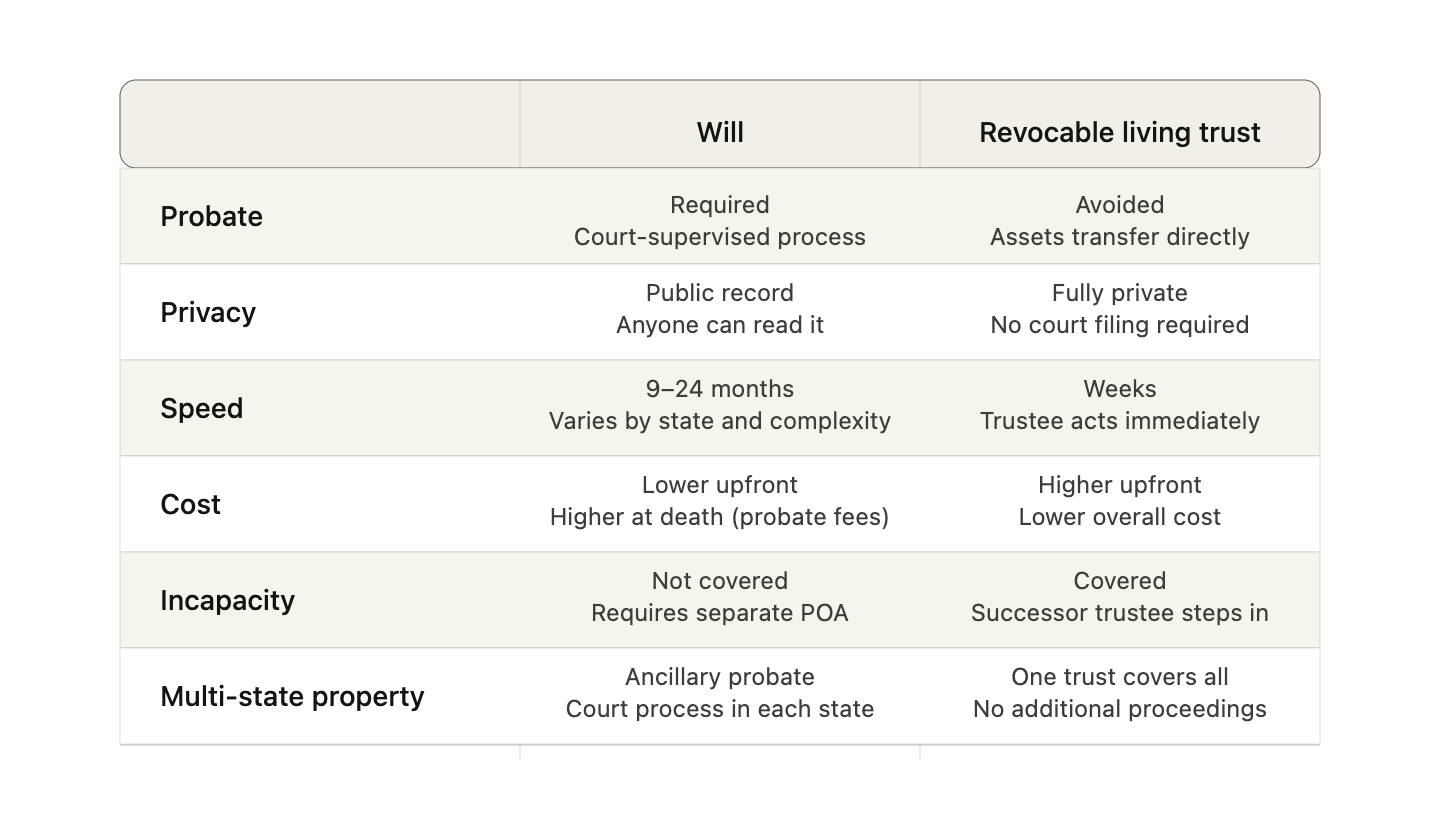
The court then runs a process called probate which includes validation, creditor notification, asset distribution. This whole process can take 9 to 24 months, cost 2–5% of your gross estate depending on state, and become public record. Anyone can look it up.
A will also does nothing if you’re incapacitated. If you’re in the ICU and can’t manage your own affairs, a will is a useless document.
A trust is a legal container you create while you’re alive. You transfer assets into it. You remain in control as the trustee. When you die, or if you’re incapacitated, a successor trustee you named takes over immediately.
No court. No public record. No waiting.
The trust doesn’t replace your will (you still need a “pour-over will” to catch anything that didn’t get transferred into the trust) but it changes what probate has to touch.
What do beneficiary designations cover?
Transfer-on-death and payable-on-death designations, TOD and POD, are useful tools. They let certain accounts pass directly to a named beneficiary without probate. Retirement accounts, brokerage accounts, life insurance can all bypass the court process when beneficiaries are properly designated.
The issue is that these don’t cover everything.
Not every state allows TOD deeds for real estate. Your LLC interest, S-corp shares, and personal property generally have no equivalent mechanism. And even where TOD deeds are available, they don’t handle incapacity.
There’s also a coordination problem. When assets pass through four different mechanisms (will, trust, TOD, POD) nobody’s checking whether they add up to a coherent plan. The gaps compound quietly over time, and they usually only surface at the worst possible moment.
Why this matters more as complexity grows
At $200K in assets and one bank account, the will-only plan is probably fine. Probate is a nuisance, not a catastrophe.
At $1.2M with a house, a brokerage account, RSUs vesting across the next three years, and two kids under ten, the calculus shifts. Add a second property in another state and you’re looking at ancillary probate: two court processes, two sets of fees, two timelines. Your family is waiting, potentially for years, on assets they need access to now.
The trust solves this. One document. One successor trustee. Assets move.
Time to switch
The question we always come back to with clients isn’t “how old are you?” It’s “has your life outpaced your current documents?”
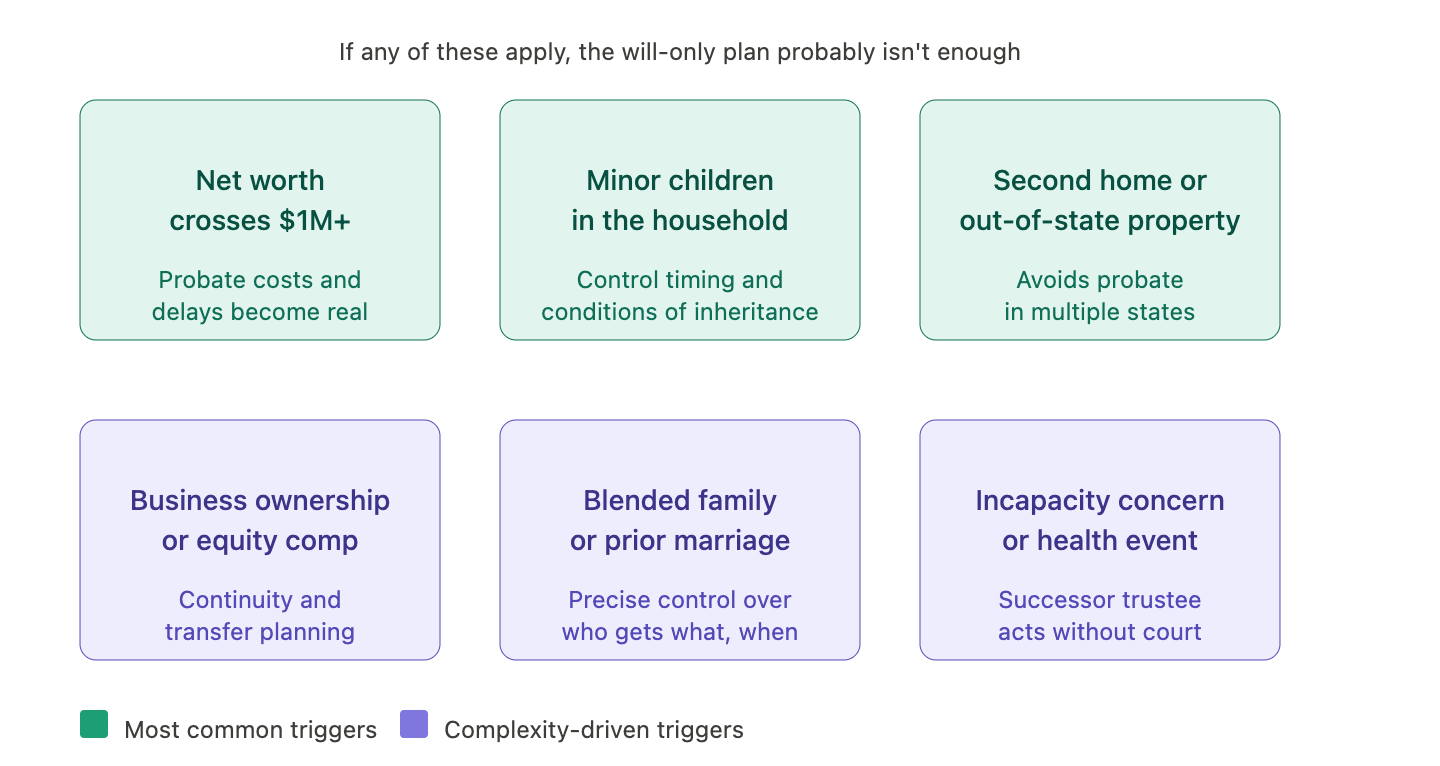
Most people we sit down with have already cleared two or three of these boxes without realizing their plan hasn't kept up.
The most common version we see
A couple sets up a will in their early 30s. Thoughtful, technically valid, signed in front of a notary. They feel good about it.
Eight years later they’re pushing $2M, they own a place at the beach, and they have two kids who are still minors. The will hasn’t been touched. The trust they talked about never got scheduled. The beneficiary designations on the 401(k) still list a family member and not the spouse.
The will isn’t wrong. It’s just not enough anymore. And the gap between what the document says and what their life actually looks like is where the expensive mistakes live.
Playing the Long Game
A will is where you start. A trust is where you end up when you’ve built something worth protecting. TOD and POD designations are useful tools but they’re not a plan. The goal isn’t the most sophisticated estate document. It’s making sure what you have actually matches the life you’re living now.
Interested in Learning More?
Let’s start with a short, 20-minute conversation to see if there’s an opportunity to improve clarity, structure, or long-term outcomes.
Upholdings Private Wealth is a registered investment adviser in applicable jurisdictions. Registration does not imply any specific level of skill or training.
This newsletter is provided for informational and educational purposes only and does not constitute investment, tax, legal, or accounting advice. It is not an offer or solicitation to buy or sell any securities or investment strategies.
Past performance is not indicative of future results. Investing involves risk, including the potential loss of principal. There is no guarantee that any strategies discussed will achieve desired outcomes.
Information is provided “as is” without warranty as to accuracy or completeness, and opinions expressed are subject to change without notice.